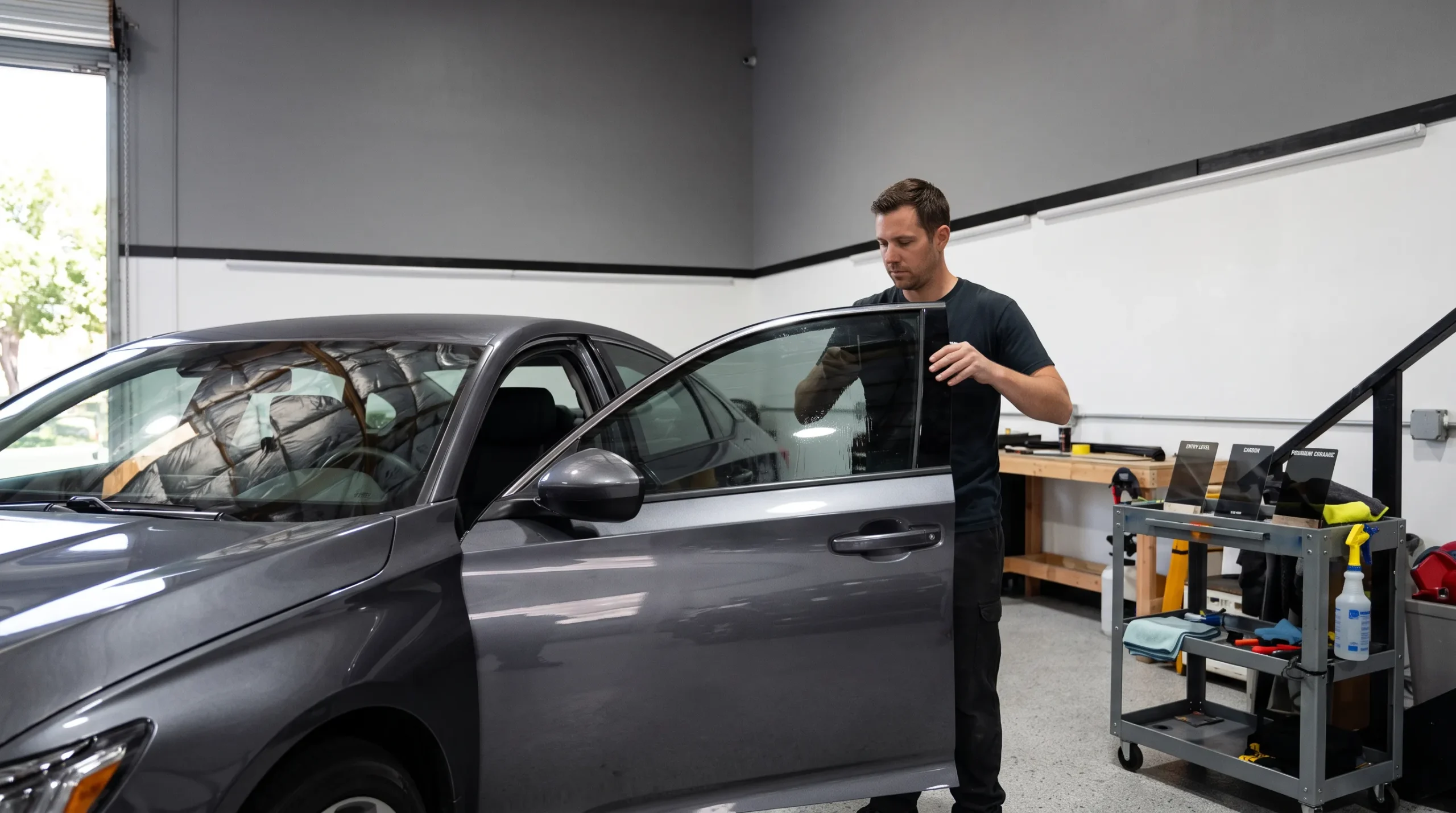
Window tinting in San Leandro, CA, can help make your car more comfortable while reducing glare, UV exposure, and unwanted sunlight entering the cabin. Whether you’re commuting along I-880, traveling toward Oakland, CA, or leaving your vehicle parked outdoors during the workday, sunlight passing through the windows can leave your seats, steering wheel, and dashboard uncomfortably hot.
Maybe you’ve been looking at window tint options and wondering why different shops recommend different film grades. One installer might suggest standard carbon tint, while another recommends ceramic film with higher heat-rejection ratings. Both films may look nearly identical once installed, so what makes them different?
Then there’s the question of cost.
What affects a window tinting quote? Does a higher film grade always mean better heat rejection? Is ceramic tint worth considering for an everyday commuter? And how do California’s window tint laws affect your options?
At High Gloss Auto Detailing, we help customers seeking professional window tinting from San Leandro, CA, and surrounding East Bay communities. Our XPEL-certified shop is located in Pleasanton, CA, where we offer carbon and ceramic window film options.
This guide explains what separates different film grades, which factors affect your installation quote, how to compare XPEL PRIME products, and what to know before choosing a shade.
Table of Contents
- Why Vehicle Owners Choose Window Tinting in San Leandro
- What Are the Different Window Tint Film Grades?
- Carbon vs. Ceramic Window Tint
- Comparing XPEL PRIME Window Tint Films
- How Window Tint Heat Rejection Is Measured
- What Affects Window Tinting Costs?
- Window Tint Packages Available Near San Leandro
- Understanding Window Tint Percentages
- California Window Tint Laws and Legal Shades
- Choosing Window Tint for Your Vehicle
- What Happens During Professional Installation?
- Window Tint Curing and Maintenance
- How to Compare Window Tint Installation Quotes
- Choosing an XPEL Window Tint Installer
- Window Tinting for San Leandro and Nearby Communities
- Frequently Asked Questions
- Schedule Your Window Tinting Appointment
- Sources and References
Why Vehicle Owners Choose Window Tinting in San Leandro, CA
San Leandro, CA, sits along major East Bay transportation routes, including I-880 and I-580.
Many residents spend time traveling between San Leandro, CA, Oakland, CA, Hayward, CA, and nearby communities for work, school, and everyday errands.
Vehicles used for these trips experience changing sun angles, bright reflections, and hours of outdoor exposure.
Automotive window film can help address several of these concerns.
Reducing Cabin Heat During Sunny Weather
If you’ve ever opened your car door after several hours in an uncovered parking lot, you know how warm the cabin can become.
Sunlight passes through vehicle glass and warms interior surfaces.
The seats, dashboard, center console, and steering wheel can absorb that energy.
Heat-rejecting window tint reduces some of the incoming solar energy passing through treated glass.
The amount of improvement depends on the film, shade, glass, and conditions.
Ceramic films are worth comparing when reducing incoming solar heat is one of your main concerns.
Making Bright Commutes More Comfortable
Sun glare can be frustrating when traveling along I-880 or approaching intersections during certain parts of the day.
Window tint reduces the amount of visible light passing through treated glass.
This can make bright sunlight less distracting.
Still, darker film isn’t automatically the right choice.
Very dark glass can make it harder to see objects outside during nighttime travel, so visibility should be considered alongside glare reduction.
Protecting Interior Surfaces From UV Exposure
Ultraviolet radiation can contribute to fading and aging of some vehicle interior materials.
Window films designed to block UV radiation can help reduce exposure through the glass receiving treatment.
XPEL reports that its PRIME automotive window film lines block 99% of harmful UV rays under the manufacturer’s published testing conditions.
Window film won’t prevent every form of wear, but it can be part of caring for your cabin.
Adding Privacy to Rear Passenger Areas
Some owners want their rear passenger windows to have a darker appearance.
This may appeal to families, SUV owners, and people who regularly carry passengers.
California generally allows more shade flexibility on rear side windows than on front side windows.
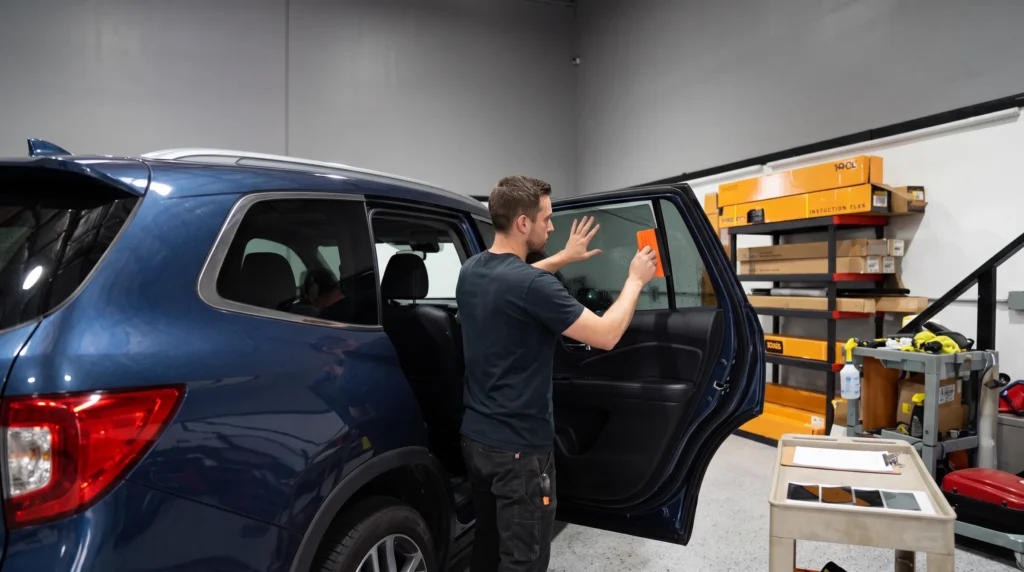
Choosing a suitable rear-window film can help balance appearance, privacy, and visibility.
What Are the Different Automotive Window Tint Film Grades?
When comparing window tinting in San Leandro, CA, you’ll hear shops describe standard, carbon, and ceramic film grades.
These terms don’t always refer to a universal rating system.
Instead, film grade usually describes the product’s construction, performance, and position within a manufacturer’s lineup.
A higher-grade product may offer stronger heat rejection or different surface characteristics.
But the exact specifications matter more than the label.
Standard Dyed Window Tint
Dyed film uses coloring agents to reduce visible light transmission and create a darker window appearance.
These films can help reduce glare and change how the vehicle looks.
Heat-rejection performance varies by product.
Some dyed films provide less infrared rejection than higher-performing ceramic films.
XPEL PRIME CS is an example of a color-stable dyed product.
It should not be confused with a carbon or ceramic film.
Carbon Window Tint
Carbon film uses carbon-based materials within the film construction.
Depending on the product, it can provide a consistent tinted appearance, UV protection, and solar heat reduction.
Carbon film is often discussed as an alternative to ordinary dyed film.
Still, the word carbon doesn’t tell you exactly how much heat a product rejects.
Different manufacturers use different constructions.
At High Gloss Auto Detailing, we advertise standard carbon window tint as an available option.
Ask our team which carbon product is currently offered and how its specifications compare with ceramic alternatives.
Ceramic Window Tint
Ceramic window film uses small ceramic particles within the film to help manage incoming solar energy.
Many ceramic products are designed to reject infrared radiation without requiring an extremely dark appearance.
That can be helpful if you want a film with good heat-rejection performance and a lighter look on windows where it is legal to install.
XPEL PRIME XR is one example of a nano-ceramic film.
Higher-Performance Ceramic Window Tint
Some manufacturers offer several ceramic film lines with different performance ratings.
XPEL PRIME XR PLUS is positioned above PRIME XR within the company’s automotive lineup.
It uses nano-ceramic technology and carries higher advertised maximum infrared-rejection figures.
Does that mean every owner should choose it?
Not necessarily.
The selected shade, your comfort goals, the vehicle’s glass, and legal placement should all be considered.
Window Tint Film Grade Comparison
| Film Category | Common Characteristics | What to Compare |
|---|---|---|
| Dyed film | Tinted appearance and glare reduction | VLT, UV rejection, heat performance |
| Carbon film | Carbon-based construction and sun control | Exact product specifications and warranty |
| Ceramic film | Infrared-rejecting ceramic technology | Infrared rejection, TSER, VLT |
| Higher-performance ceramic | Additional heat-rejection capabilities within some product lines | Actual shade-specific ratings and coverage |
Here’s what matters: A film grade is only useful when you know which product is being installed.
Ask for the exact manufacturer and film series before making your choice.
Carbon vs. Ceramic Window Tint: Which Is Better for Your Car?
Carbon and ceramic film can both produce an attractive finish.
The difference becomes more noticeable when you compare their measured performance.
When Carbon Window Tint Makes Sense
Carbon film may be worth discussing if you want a consistent tinted appearance and suitable sun-control performance on legally permitted windows.
The selected film can also offer UV protection and reduced glare, depending on its specifications.
Ask about the product’s heat-rejection ratings rather than assuming every carbon film performs the same way.
When Ceramic Window Tint Makes Sense
Ceramic film may be a better match when reducing cabin heat is a major goal.
Some ceramic products reject more infrared radiation than standard dyed or carbon films.
This can matter for owners who park outdoors or spend time commuting in sunny weather.
A suitable ceramic film can also offer measurable infrared rejection at lighter shades.
Does Ceramic Tint Interfere With Electronics?
XPEL advertises no signal interference for its PRIME CS, XR, and XR PLUS window films.
Its nano-ceramic products use nonmetalized technology designed to avoid the signal concerns associated with some metallic films.
This may appeal to vehicle owners who use GPS, connected vehicle features, and electronic toll equipment.
Should You Choose Based on Shade Alone?
No.
Two films may look similar but have different heat-rejection specifications.
If you’re researching window tinting in San Leandro, CA, compare the product’s performance measurements before settling on an appearance.
Comparing XPEL PRIME Window Tint Film Grades
High Gloss Auto Detailing is XPEL certified and an XPEL vendor.
XPEL manufactures several automotive window film products designed for different appearance and heat-control goals.
The XPEL PRIME window tint lineup includes PRIME CS, PRIME XR, and PRIME XR PLUS.
These products are useful examples when comparing grades. Contact us to confirm which specific XPEL products and shades are currently available at our shop.
XPEL PRIME CS: Color-Stable Dyed Film
PRIME CS uses color-stable dyed technology.
XPEL advertises infrared rejection of up to 35% and rejection of 99% of harmful UV rays.
It is designed for owners who want a tinted appearance, glare reduction, and UV protection.
PRIME CS is not a ceramic film.
It is also not the same as the separately advertised standard carbon option on our shop’s service page.
XPEL PRIME XR: Nano-Ceramic Film
PRIME XR uses multi-layer nano-ceramic technology.
XPEL advertises up to 85% infrared rejection and 99% UV rejection.
For vehicle owners researching window tinting in San Leandro, CA, who spend time commuting or parking outdoors, PRIME XR is worth comparing for its heat-control capabilities.
The actual performance depends on the selected shade and the manufacturer’s test method.
XPEL PRIME XR PLUS: Higher-Performance Ceramic Film
PRIME XR PLUS uses nano-ceramic technology and has an advertised maximum infrared rejection rating of 96%.
XPEL also lists 99% rejection of harmful UV rays.
XR PLUS may appeal to owners who are comparing films for stronger infrared heat rejection.
The manufacturer’s maximum rating does not mean every shade rejects 96% of all solar heat.
That’s why the total solar energy rating should also be reviewed.
XPEL PRIME Film Comparison
| XPEL Film | Film Technology | Advertised Maximum Infrared Rejection | Advertised UV Rejection |
|---|---|---|---|
| PRIME CS | Color-stable dyed | Up to 35% | 99% |
| PRIME XR | Nano-ceramic | Up to 85% | 99% |
| PRIME XR PLUS | Nano-ceramic | Up to 96% | 99% |
Source: XPEL PRIME Window Tint.
These ratings are manufacturer-advertised maximums. They do not apply equally to every shade or describe the percentage of all solar heat rejected.
How Window Tint Heat Rejection Is Measured
Understanding film measurements can help you compare window tinting in San Leandro, CA, without relying on advertising claims alone.
Three measurements are especially useful.
Infrared Rejection
Infrared rejection describes how much infrared radiation a film rejects within a stated wavelength range or at a stated wavelength.
Infrared energy contributes to the heat you feel from sunlight.
Different testing methods can produce different ratings.
That’s why infrared percentages should be compared alongside the manufacturer’s test details.
Total Solar Energy Rejected
Total Solar Energy Rejected, or TSER, measures how much incoming solar energy is rejected.
It considers a wider portion of sunlight than a single infrared measurement.
A product advertised with 96% infrared rejection does not necessarily reject 96% of total solar energy.
For someone concerned about cabin temperature, comparing TSER figures is another useful step.
XPEL makes product data available through its official film specifications page.
Visible Light Transmission
Visible Light Transmission, or VLT, tells you how much visible light passes through the glass or film.
A lower VLT creates a darker appearance.
A higher VLT allows more light to pass through.
VLT and heat rejection are not the same measurement.
A lighter ceramic film may reject more infrared energy than a darker film made with another technology.
Why These Ratings Matter
Suppose you’re comparing two films that look almost identical on a sample window.
One may have stronger infrared rejection, while the other offers a different combination of shade and solar control.
Looking at the product data helps you choose based on performance instead of appearance alone.
What Affects Window Tinting Costs in San Leandro, CA?
One of the most common questions about window tinting in San Leandro, CA, concerns installation costs.
There isn’t one quote that represents every car.
A compact sedan with a few windows receiving film involves different work than a large SUV with multiple glass panels.
Here are the factors that commonly affect a professional tinting quote.
1. Window Tint Film Grade
The selected film is one factor.
Standard carbon and ceramic products have different constructions and specifications.
Higher-performance film lines may also involve different material requirements.
When comparing quotes, ask whether they include carbon film, nano-ceramic film, or another product.
A quote that only says window tint doesn’t tell you enough.
2. Number of Windows Receiving Film
The number of windows matters.
Treating selected rear passenger windows involves less glass coverage than a larger installation.
A full-vehicle request may include multiple side and rear windows, depending on the legal scope and the vehicle.
Ask which windows are included before comparing services.
3. Vehicle Size and Body Style
A two-door coupe, four-door sedan, pickup truck, and three-row SUV can have very different glass areas.
Larger or more involved installations may require additional film and labor.
Vehicle size alone doesn’t determine the entire quote.
Window shapes and access also matter.
4. Curved or Complex Glass
Some rear windshields have pronounced curves.
Certain vehicles also have small quarter windows, unusual seals, or large glass panels.
These features can require more preparation and careful film fitting.
When requesting a quote, share your vehicle’s year, make, and model.
5. Removing Existing Window Tint
If your car already has aftermarket window film, the old material may need to be removed.
That process can involve carefully removing the film and cleaning remaining adhesive.
Rear defroster lines and other sensitive glass features require extra attention.
Let your installer know about existing tint before arranging an appointment.
6. Glass Condition and Preparation
Dirty glass, leftover adhesive, damaged seals, or unusual contamination can complicate installation.
The installer may need to spend additional time preparing the surface.
Proper glass cleaning helps reduce the chance of dust or residue becoming trapped beneath the film.
7. Film Coverage and Legal Requirements
California restricts aftermarket film on the front side windows and windshield.
This affects which coverage options can legally be completed on a vehicle used on public roads.
A full-vehicle request should be discussed window by window rather than assuming the same dark shade can be applied everywhere.
8. Installation Work and Warranty Terms
A professional tinting quote should explain the film, coverage, installation, and applicable warranty.
XPEL publishes warranty information for its PRIME automotive products.
High Gloss Auto Detailing also advertises warranty support through the shop and manufacturer.
Make sure you understand which coverage applies to the selected film and installation.
Want an accurate quote?
Call High Gloss Auto Detailing at (510) 542-3295 or contact our shop online.
Tell us your vehicle’s year, make, model, current tint condition, and the windows you want treated.
Window Tinting Packages Available Near San Leandro, CA
High Gloss Auto Detailing advertises four window tint coverage options on our window tinting service page.
The listed packages are available with standard carbon or ceramic film options, subject to product availability and legal installation requirements.
Window Tint Package Comparison
| Package | Advertised Coverage Focus | What to Confirm |
|---|---|---|
| Windshield Strip | Upper windshield area | Legal placement and material |
| 2-Front Window Match | Front driver and passenger windows | Strict California clear-film requirements |
| Full Vehicle | Multiple vehicle windows | Exact window list and legal coverage |
| Full Windshield | Windshield area | Whether a statutory exception permits the proposed installation |
Windshield Strip
A windshield strip is applied to the upper portion of the front windshield.
Its purpose is to reduce some bright sunlight entering near the top of the glass.
California has particular requirements for the strip’s position and material.
Ask our team which options are permitted for your vehicle.
2-Front Window Match
Some vehicle owners want their front side windows to resemble darker factory rear glass.
Our website lists a 2-Front Window Match option.
California does not generally allow ordinary dark aftermarket film on the windows directly beside the front seats.
The legal clear-film exception has strict requirements.
Ask whether a proposed treatment qualifies rather than assuming any matching shade can be installed.
Full Vehicle Window Tint
A full-vehicle package is intended for owners considering film on multiple windows.
The permitted coverage may differ between front and rear glass.
Rear side windows usually offer more shade flexibility, while front side windows and windshields are restricted.
Confirm the exact windows and films included in the final service.
Full Windshield
Our website also lists a Full Windshield option.
Full-windshield aftermarket film is highly restricted under California law, with narrow exceptions.
An advertised option does not mean that every product or vehicle qualifies for installation.
Ask our team to review the legal requirements before requesting full-windshield film.
Understanding Window Tint Percentages and Shades
Window tint shade percentages describe visible light transmission.
The smaller the percentage, the darker the film generally appears.
Common Window Tint Shades
| Nominal Film VLT | General Appearance |
|---|---|
| 5% | Very dark |
| 20% | Dark |
| 35% | Medium-dark |
| 50% | Moderately tinted |
| 70% | Light |
| 88% or higher | Very light or nearly clear |
These descriptions are not a list of legally approved shades for every California vehicle window.
Is Darker Window Tint Better?
Not always.
A darker film can reduce more visible sunlight, but it may also make nighttime visibility more difficult.
It doesn’t automatically reject more infrared heat than a lighter ceramic film.
For window tinting in San Leandro, CA, choose a shade with both comfort and practical visibility in mind.
What About Factory Privacy Glass?
Some SUVs and trucks already have darker rear glass.
Factory privacy glass can change the appearance of any additional film.
The existing glass also affects the final combined visible light transmission.
Ask whether your installer can check the completed glass-and-film combination when necessary.
California Window Tint Laws: What’s Legal in San Leandro, CA?
California window tint requirements apply throughout the state, including San Leandro, CA.
The main rules are found in California Vehicle Code Section 26708.
The California Highway Patrol also explains the restrictions in its window tint FAQ.
California Window Tint Rules at a Glance
| Window Location | General California Requirement |
|---|---|
| Front driver and passenger side windows | Ordinary dark aftermarket tint is prohibited; a narrow clear UV-film exception applies |
| Rear passenger side windows | Darker tint is generally permitted, subject to applicable rules |
| Rear windshield | Tint is generally permitted when compliant outside mirrors are present on both sides |
| Front windshield | Aftermarket film is restricted, with limited exceptions |
Front Side Window Tint Requirements
California allows qualifying clear, colorless, transparent UV-protective material on the front side windows when statutory conditions are met.
Under Vehicle Code Section 26708(d):
- The film itself must transmit at least 88% of visible light.
- The finished glass-and-film combination must meet the applicable 70% minimum visible light transmission requirement.
- The material must be designed to improve UVA protection.
- The required signed certificate must be kept in the vehicle.
- Film that becomes damaged or obstructs clear vision must be removed or replaced.
This means a film labeled 70% VLT is not automatically legal for front side windows.
The film and completed glazing must both meet the applicable requirements.
Rear Side Window Tint
California generally permits darker film on side windows behind the driver.
That makes rear passenger windows a common place for owners to consider privacy and glare reduction.
Keep nighttime visibility in mind when selecting a darker shade.
Rear Windshield Tint
Rear windshield tint is generally permitted when the vehicle has compliant outside rearview mirrors on both sides.
Vehicle equipment and other applicable requirements still matter.
Windshield Tint Strip Rules
California allows qualifying transparent material across the topmost portion of the windshield.
The law includes a placement rule requiring the bottom edge to be at least 29 inches above the undepressed driver’s seat, measured according to the procedure described in Section 26708(c).
The strip must also satisfy restrictions related to color, lettering, and reflected glare.
This is more precise than the often-repeated claim that any four-inch strip is legal.
Is Full Windshield Ceramic Tint Legal?
Full-windshield aftermarket film is restricted.
California includes narrow exceptions, including certain qualifying clear UV-protective material used under medical conditions with required documentation.
Those exceptions do not give general permission to install dark film across an entire windshield.
If you’re considering window tinting in San Leandro, CA, ask your installer to explain which products and windows comply with the current law.
How to Choose Window Tint for Your Vehicle
The right film depends on your vehicle, everyday use, and what you want to improve.
For Daily I-880 Commuters
If you spend time traveling between San Leandro, CA, Oakland, CA, and Hayward, CA, you may want to focus on glare reduction and heat rejection.
Compare the ceramic film options and ask about actual performance measurements.
A film with good infrared rejection may help reduce incoming solar heat through treated glass.
For SUVs and Family Vehicles
Larger vehicles may have several rear passenger windows.
Families may want to discuss rear-window privacy, UV protection, and passenger comfort.
A darker rear-window film may be an option, but visibility after sunset should also be considered.
For Tesla Owners
Some Tesla models have large glass panels and panoramic roofs.
These features can affect how much sunlight enters the cabin.
Ask which glass surfaces are suitable for aftermarket film and whether the selected product is compatible with the vehicle manufacturer’s guidance.
For Owners Who Park Outdoors
A car parked in direct sunlight can still become very hot, even with ceramic tint.
Heat-rejecting film reduces some incoming solar energy through treated windows, but it does not make a parked vehicle safe for children or pets.
Don’t rely on tint as a substitute for safe vehicle use.
For Nighttime Commuters
If you regularly travel after dark, avoid choosing rear-window shades based only on privacy.
A lighter film may offer better outward visibility in low-light conditions.
For window tinting in San Leandro, CA, a useful choice is one that balances heat control, appearance, visibility, and legal placement.
What Happens During Professional Window Tint Installation?
Professional tinting involves more than applying film to a window.
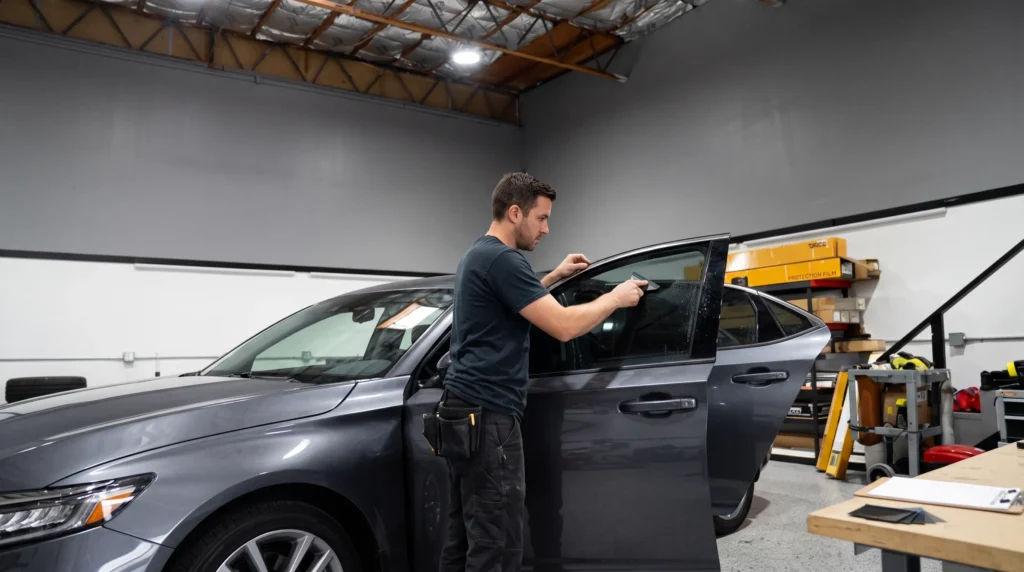
At High Gloss Auto Detailing, our published process includes measuring the glass, cleaning and preparing surfaces, and applying the film.
Step 1: Vehicle and Glass Inspection
The installer checks the glass for existing tint, damage, dirt, and any vehicle features that may affect installation.
Rear defroster lines, glass seals, and curved windows may require additional attention.
Step 2: Film and Coverage Selection
Before application, the film series and selected windows should be confirmed.
This is also the time to discuss California legal requirements.
Ask for the exact product name and the areas receiving film.
Step 3: Cleaning the Glass
Glass preparation helps reduce dust, residue, and trapped contamination beneath the film.
If old window tint is present, removal and adhesive cleaning may be required.
Step 4: Fitting and Applying the Film
The installer prepares the film for the shape of each window.
An application solution helps position the film before excess moisture is removed.
The installer works around curves, seals, and other glass features.
Step 5: Final Inspection
After application, the installer checks the film’s position, edges, and appearance.
Some temporary moisture or haze may remain during curing.
The installer should explain what is normal and when to contact the shop.
Window Tint Curing and Maintenance: What to Expect
After installation, window film needs time to dry and settle.
Proper aftercare helps maintain its appearance.
Wait Before Lowering Your Windows
According to XPEL’s official window film care instructions, owners should wait approximately one to five days before lowering or cleaning newly tinted windows, depending on climate.
Follow the instructions for your particular installation.
Temporary Haze Can Be Normal
XPEL notes that haze or small moisture bubbles may remain for up to ten days after installation.
These conditions can clear as moisture evaporates.
Don’t try to puncture bubbles or peel the film.
If a problem remains beyond the expected curing period, contact your installer.
Use Suitable Glass Cleaners
Once the film is ready for cleaning, use a soft microfiber towel slightly dampened with water.
XPEL recommends mild, non-ammonia glass cleaner when needed.
Avoid abrasive pads, harsh scrubbing, and sharp tools.
Keep Your Interior Clean
Fingerprints, dust, and residue can still build up on tinted glass.
Careful cleaning helps maintain visibility and appearance.
Our professional auto detailing services can also help with general interior and exterior vehicle care.
How to Compare Window Tinting Quotes Without Getting Confused
Two tinting quotes aren’t necessarily describing the same service.
One might include a standard film on selected rear windows.
Another might involve a different film grade, additional glass, or removing old tint.
Before choosing an installer, ask a few questions.
Which Exact Film Is Included?
Request the product manufacturer and film series.
Don’t settle for a description that only says ceramic tint.
Which Windows Will Be Treated?
Ask for a written list of the windows included.
Confirm whether the rear windshield, quarter windows, or other glass panels are part of the proposed work.
Is Old Film Removal Included?
If your vehicle has existing tint, ask whether removal and adhesive cleaning are part of the service.
What Warranty Applies?
Ask about the manufacturer warranty and any separate installer coverage.
You should understand the written terms, exclusions, and any registration requirements.
What Aftercare Will I Receive?
Ask when you can lower your windows and begin cleaning the film.
You should leave with instructions for the product installed on your vehicle.
These questions make it easier to compare window tinting in San Leandro, CA, based on the actual work and film rather than package names alone.
How to Choose an XPEL Window Tint Installer Near San Leandro, CA
The film is only one part of a good tint installation.
Proper preparation, accurate fitting, and clear communication matter too.
Look for Product Knowledge
Your installer should explain the difference between dyed, carbon, and ceramic film technologies.
They should also be able to discuss VLT, infrared rejection, and TSER.
Ask About Installer Certification
High Gloss Auto Detailing is XPEL certified and an XPEL vendor.
Our team works with XPEL automotive window film and related vehicle protection products.
Learn more about us on our About Us page.
Check Warranty Details
High Gloss Auto Detailing advertises window tint warranty support through the shop and manufacturer.
XPEL also publishes warranty information for its PRIME window films.
Review the XPEL warranty information and request the documents applicable to your installation.
Ask About Previous Work
Customer reviews and photos may help you assess installation quality.
Look at film edges, glass clarity, and how cleanly the film follows curved windows.
Check the Shop’s Other Services
If you also want to care for your vehicle’s exterior, High Gloss Auto Detailing offers:
These services address different needs from automotive window tint, but they can be discussed during the same consultation.
Window Tinting Services for San Leandro, CA, and Nearby East Bay Communities
High Gloss Auto Detailing welcomes customers looking for window tinting in San Leandro, CA, at our shop in Pleasanton, CA.
Our team also serves vehicle owners from nearby East Bay communities.
San Lorenzo, CA
Customers from San Lorenzo, CA, can contact us about carbon and ceramic window tint, rear-window coverage, and heat-rejection options.
Hayward, CA
If you commute regularly or park outdoors in Hayward, CA, our team can help you compare available XPEL window film choices.
Castro Valley, CA
Vehicle owners from Castro Valley, CA, are welcome to discuss tint shades, film grades, and glass coverage options.
Oakland, CA
Customers from Oakland, CA, can contact our team about legally permitted automotive window tint and XPEL ceramic film products.
Dublin, CA
We serve Dublin, CA, customers seeking window tinting, ceramic coating, PPF, and other vehicle appearance services.
Pleasanton, CA
Our shop is located at:
High Gloss Auto Detailing
7034 Commerce Cir Suite E
Pleasanton, CA 94588
Our physical location is in Pleasanton, CA, not San Leandro, CA. Customers from San Leandro and surrounding communities can arrange an appointment at our shop.
Frequently Asked Questions About Window Tinting in San Leandro, CA
1. How Much Does Window Tinting Cost in San Leandro, CA?
A professional window tinting quote depends on the type of film, number of windows, vehicle design, existing tint removal, and preparation requirements.
Carbon and ceramic films can have different specifications, while complex glass shapes may require more installation work.
For a quote based on your vehicle, call High Gloss Auto Detailing at (510) 542-3295 or complete our contact form.
2. What Is the Difference Between Carbon and Ceramic Window Tint?
Carbon film uses carbon-based technology to create its appearance and manage incoming sunlight.
Ceramic film uses ceramic particles designed to help reject infrared radiation.
Some ceramic films offer higher heat-rejection performance than standard carbon or dyed films.
The exact difference depends on the products being compared.
Ask about the manufacturer’s specifications rather than choosing solely by the film category.
3. Is XPEL PRIME XR PLUS Better Than PRIME XR?
PRIME XR PLUS has a higher advertised maximum infrared-rejection rating than PRIME XR.
XPEL lists up to 96% infrared rejection for XR PLUS and up to 85% for XR.
Both use nano-ceramic technology and offer UV protection.
The right choice depends on your heat-control goals, film availability, preferred appearance, and the shades legally permitted for the selected windows.
4. Is 35% Window Tint Legal in California?
California generally allows darker tint on rear side windows, subject to applicable conditions.
A 35% aftermarket film does not meet the state’s narrow clear UV-film exception for front side windows.
Qualifying front-side film must have at least 88% visible light transmission on its own and meet the other statutory conditions.
The window location matters when determining whether a particular film can legally be installed.
5. Does Ceramic Window Tint Keep My Car Cooler?
Ceramic tint can reduce solar heat entering through treated glass.
Products such as XPEL PRIME XR and XR PLUS are designed for infrared heat rejection.
The actual temperature difference depends on the vehicle, window coverage, sunlight, and selected film.
Ceramic tint will not stop a parked vehicle from becoming dangerously hot.
Always follow safe parking practices.
6. How Long Does Window Tint Installation Take?
Installation time depends on the vehicle, number of windows, film selection, glass shapes, and any existing film removal.
Tinting a small number of windows may involve less work than a larger installation.
Curved rear glass and specialty window features may also affect the appointment.
Contact High Gloss Auto Detailing with your vehicle information to discuss scheduling.
7. Where Can I Get XPEL Window Tinting Near San Leandro, CA?
High Gloss Auto Detailing is an XPEL-certified business serving vehicle owners from San Leandro, CA, and nearby East Bay communities.
Our shop is located at:
High Gloss Auto Detailing
7034 Commerce Cir Suite E
Pleasanton, CA 94588
Phone: (510) 542-3295
Business Hours:
- Monday through Friday: 9:30 AM to 6:30 PM
- Saturday: 10:00 AM to 6:30 PM
We offer carbon and ceramic window tinting options, along with ceramic coating, paint protection film, auto detailing, and paint correction.
Visit our window tinting service page to review the advertised options.
Schedule Window Tinting Near San Leandro, CA
Choosing window tinting in San Leandro, CA, starts with understanding what you want from the film.
If heat rejection is your biggest concern, compare the specifications of the available ceramic products.
If you want a darker rear-window appearance, ask about standard carbon and ceramic shade options.
And if you’re thinking about front-side or windshield film, make sure the proposed installation meets California law.
At High Gloss Auto Detailing, our XPEL-certified team can help you compare available film grades, discuss the windows you want treated, and explain what to expect from the installation.
We welcome customers from San Leandro, CA, San Lorenzo, CA, Hayward, CA, Castro Valley, CA, Oakland, CA, Dublin, CA, and surrounding East Bay communities.
Ready to compare window tint options for your vehicle?
Call (510) 542-3295 to discuss film grades, coverage, and a personalized quote.
You can also contact High Gloss Auto Detailing online to request an appointment.
Visit our shop:
High Gloss Auto Detailing
7034 Commerce Cir Suite E
Pleasanton, CA 94588
Choose window film based on performance, appearance, legal coverage, and the way you use your vehicle.
Sources and References
The following sources support the advertised services, manufacturer film ratings, warranty information, California tint requirements, and film maintenance guidance discussed in this article.
| Source Title | Publisher | Publication Date | URL |
|---|---|---|---|
| Window Tinting in Pleasanton, CA & Dublin, CA | High Gloss Auto Detailing | Not listed | Window Tinting Services |
| Contact High Gloss Auto Detailing | High Gloss Auto Detailing | Not listed | Contact and Shop Information |
| XPEL PRIME Window Tint | XPEL | Not listed | XPEL PRIME Product Comparison |
| XPEL Product Specifications | XPEL | Not listed | Window Film Technical Data |
| Warranty Information | XPEL | Not listed | XPEL Automotive Film Warranties |
| XPEL Product Care Instructions | XPEL | Not listed | XPEL Window Film Care |
| California Vehicle Code Section 26708 | California State Legislature | Amended effective January 1, 2026 | California Window Tint Law |
| Frequently Asked Questions: Vehicle Modification | California Highway Patrol | Not listed | CHP Window Tint Guidance |
Film specifications, product availability, warranty conditions, and tint package details may change. Legal information reflects California requirements reviewed in October 2026 and is intended as general guidance. Confirm the applicable law, film specifications, and written warranty before installation.
Window Tinting in San Leandro, CA: Cost Factors and Film Grades - High Gloss Auto Detailing XPEL Certified Installer

Window Tinting in San Leandro, CA: Cost Factors and Film Grades Premier Certified XPEL Installer. Window tinting in San Leandro, CA, can help make your car
Product Brand: High Gloss Auto Detailing
5
Pros
- Discover the best ceramic coating services in Pleasanton, CA, with High Gloss Auto Detailing. Protect your car’s paint with Ceramic Pro, the industry leader in automotive protection. Call us today or schedule an appointment online!